
A deposit is often the point where a buyer loses leverage. Here is how to check a moissanite jewelry supplier before you send one, document by document.
Why the deposit is the decision point
Before you pay, you can walk away for free. After you pay, every disagreement costs you money, time, or both. That is why the useful question is not “is this supplier good” but “what can this supplier prove, in writing, before I commit”.
A real manufacturer and a middleman can both send you a nice catalogue. They cannot both produce the same paperwork, because the paperwork comes from owning the process: the licence at the registered address, the hallmark struck inside the band, the casting photos taken on the same floor the ring was made on.
What follows is the sequence we would use ourselves if we were buying. It takes about a week and costs nothing until you place a trial order.
1. Ask for five documents, not a price list
Documents are hard to fake at scale because each one is issued by someone else. Ask for all five in one message, and see which ones arrive quickly.
| Document | What it proves | How to check it |
|---|---|---|
| Business licence | A legal entity exists, with a registered scope and address | Match the company name on the licence to the name on the quotation and to the name on the bank account. Three different names is a stop sign. |
| 925 hallmark photo | The metal is sterling silver, not plated brass | Ask for a close-up of the stamp inside the band or on the clasp tag, taken on the finished piece. Ask whether the stamp is applied in-house. |
| GRA report for the stones | What the stone actually is, and its colour | Verify the report number with the issuing lab, then check the weight and measurements on the report against the piece. |
| Dated in-process photos | The order exists and is moving through a real line | Ask for photos at casting, at stone setting, and at final QC, each with the date visible. |
| Invoice and HS code | The supplier exports regularly and knows the tariff classification | Jewellery of silver falls under HS 7113. A vague or wrong code usually means the paperwork is handled by a forwarder, not the supplier. |
If a supplier sends four of the five within a day and explains why the fifth takes longer, that is a normal factory. If the answer is “we will send everything after you pay”, the documents are not the problem — the supplier is.
2. Four questions that separate a factory from a middleman
Price cannot tell you this. Answers can, if you ask questions that only the production side can answer precisely.
- Who owns the mould? A factory will tell you the mould is kept for your design and can be reused on the next run. A middleman has to ask someone else. Background: factory or trading company.
- How long have you been producing, and at which address? The year and the district should match the licence. See how long we have been in business and where we are located.
- How many pieces a month, and on how many lines? Capacity with no unit and no line count is a guess. Our figure is on production capacity.
- What do you do in-house, and what do you send out? Almost every factory outsources something. The honest answer names it.
3. Read the quotation as a document, not a number
A quotation that only states a unit price is not a quotation, it is an opening position. Ask for six lines: unit price, MOQ per design, mould or setup cost, sampling time, production time, and the incoterm with the freight cost.
Then check the arithmetic against the material. A 925 silver ring with a 16 mm pear-cut moissanite cannot land at the same price as a brass ring with cubic zirconia, because the stone and the metal are the two largest line items. When a quote is far below the field, the substitution usually happens later, at production, when you have already paid.
Our own terms, so you have something to compare: one piece on stock designs, thirty pieces per design for custom work, mould free from thirty pieces and USD 45 below that, sampling in five to seven days, production in seven to ten working days, air freight seven to ten days. The detail is on how pricing is calculated and minimum order quantity.
4. Run the trial order as a test, not as a favour
A trial order is the only real evidence you will get before volume. Treat it as a test with pass and fail conditions, not as a small favour.
- Write down the pass conditions before you order: stone colour, metal weight, plating colour, clasp type, hallmark position.
- Keep one piece from the approved sample, sealed and labelled, as the reference for the production run.
- Pay the balance against inspection, not against a shipping date.
- Ask how fast a sample can be sent, and whether the sample cost is credited on the bulk order. See sample lead time and small trial orders.
5. Inspect before the balance, not after arrival
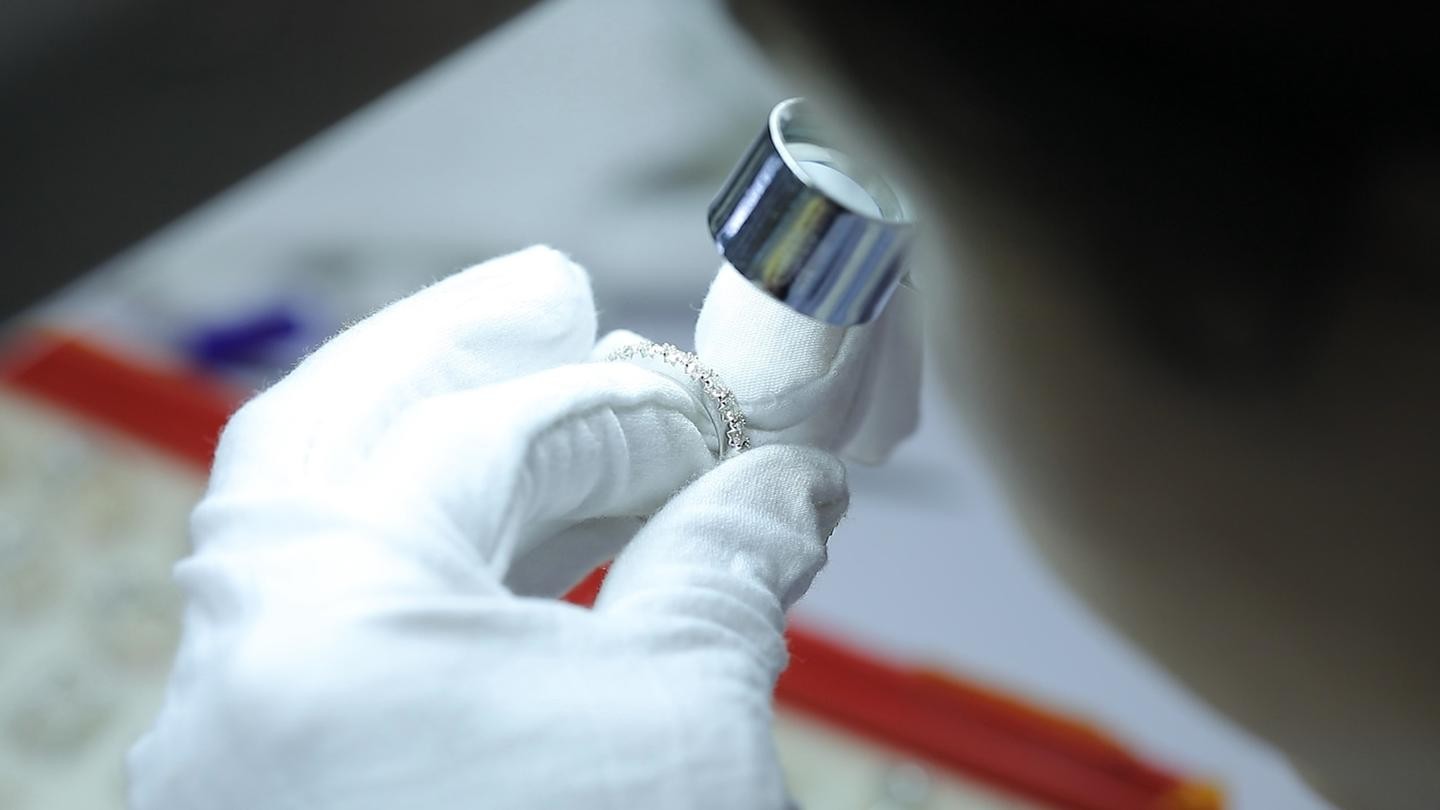
The cheapest inspection you will ever pay for is the one that happens in the factory, before the carton is sealed. Ask for three things: a piece count by item number, photos of every item number laid out, and a close-up of the hallmark on three random pieces.
If the order includes moissanite, ask for the stone weight and measurements to be checked against the GRA report on the finished piece, not on the loose stone. How to read that report: verify a GRA moissanite report. Our inspection process is described on checking goods before shipment.
6. Six red flags worth walking away from
| What you see | What it usually means |
|---|---|
| A price 30 to 40 percent below everyone else, quoted in minutes | The stones were never costed. Expect a substitution at production. |
| Only a personal name on the proforma invoice | No legal entity to claim against if the order goes wrong. |
| “Any size, any design” with no mould cost mentioned | Either a stock blank is being plated, or the mould appears later as a surprise line. |
| The same product photos appear on five different suppliers’ pages | The photos are stock, not their production. |
| No video call from the workshop, only a showroom | The workshop is not theirs. |
| The sample stone colour differs from the approved photo | Your approval was not treated as the production standard. |
7. The checklist, on one page
- Licence name, quotation name and bank account name are identical.
- Hallmark photo taken inside a finished piece, not on a CAD render.
- GRA report number verified with the lab, and the stone matches the report.
- MOQ, mould cost, sampling time, production time and what happens if QC fails are all in writing.
- Dated in-process photos at casting, setting and QC.
- Pre-shipment inspection completed before the balance is paid.
- One named contact who answers within one business day.
What the sample has to prove, and what it cannot
The sample proves the design and the finish. It does not prove the production run, because a sample is made one at a time by the most experienced setter on the floor. Treat the sample as a specification document, not as a promise about volume.
- Weight on your own scale. Ask for the target weight in the quotation, then weigh the sample. A ring quoted at 4.3 g that arrives at 3.6 g has less metal in it, and will wear thinner at the shank.
- Stone colour in daylight, not under a lamp. Take the sample outside at midday. Moissanite graded D should stay white; a lower grade turns warm or grey once the showroom lighting is gone.
- The hallmark, photographed inside the finished piece. If it is missing on the sample, it will be missing on the order, and you will be the one explaining that to a customs officer or a customer.
- Clasp and hinge behaviour. Open and close the clasp twenty times. A lobster clasp that already feels loose on day one will fail in the customer’s hands, and returns cost more than the clasp.
- Plating at the edges. Look at the inside of the band and the edge of the setting, where plating is thinnest. Uneven colour there is the first place wear will show.
What the sample cannot prove is consistency. That is what the next two sections are for.
Comparing two suppliers without emotion
Once you have two or three quotations and two or three samples, the decision stops being about impressions. Score the suppliers on the same seven lines, and let the arithmetic decide.
| Criterion | What a good answer looks like | Weight |
|---|---|---|
| Legal entity and bank name | All three names identical on licence, quotation and invoice | Gate, not a score |
| Written specification | Weight, stone size, plating colour and clasp type stated per item number | 20 |
| Sample vs quotation match | The sample matches every line of the written specification | 20 |
| Mould and MOQ terms | Mould cost, MOQ per design and reuse rights stated in writing | 15 |
| Lead time realism | Sampling, production and transit quoted as three separate numbers | 15 |
| Inspection terms | Balance payable after inspection, with a stated remedy if QC fails | 15 |
| Response time | One named contact, answers within one business day | 15 |
Two suppliers rarely tie. What usually separates them is not the price line but the two rows that are easiest to skip: the written specification and the inspection terms. Those are also the two rows that decide whether a dispute is a conversation or a loss.
The reorder is where suppliers actually fail
Most first orders arrive. The failures show up on the second one: a slightly different stone colour, a band a little thinner, a clasp from another batch, packaging that no longer matches. None of these is dramatic enough to reject a shipment, and all of them are visible to your customer.
- Ask who keeps the mould, and for how long. If the mould is discarded after the run, the next order is a new tool, and a new tool means small differences.
- Ask for the stone batch to be reserved. Moissanite colour is consistent within a batch and can drift between batches. A supplier who reserves the batch for your reorder is a supplier who expects a reorder.
- Keep the approved sample sealed and labelled. It is the only document that settles a colour argument six months later.
- Record the weight per item number. Weight drift is the quietest defect in silver jewellery, and the easiest to measure on arrival.
A factory that answers these three sections without hesitating is telling you something useful: it has been through a reorder before, with a buyer who checked.
Where we stand on each point
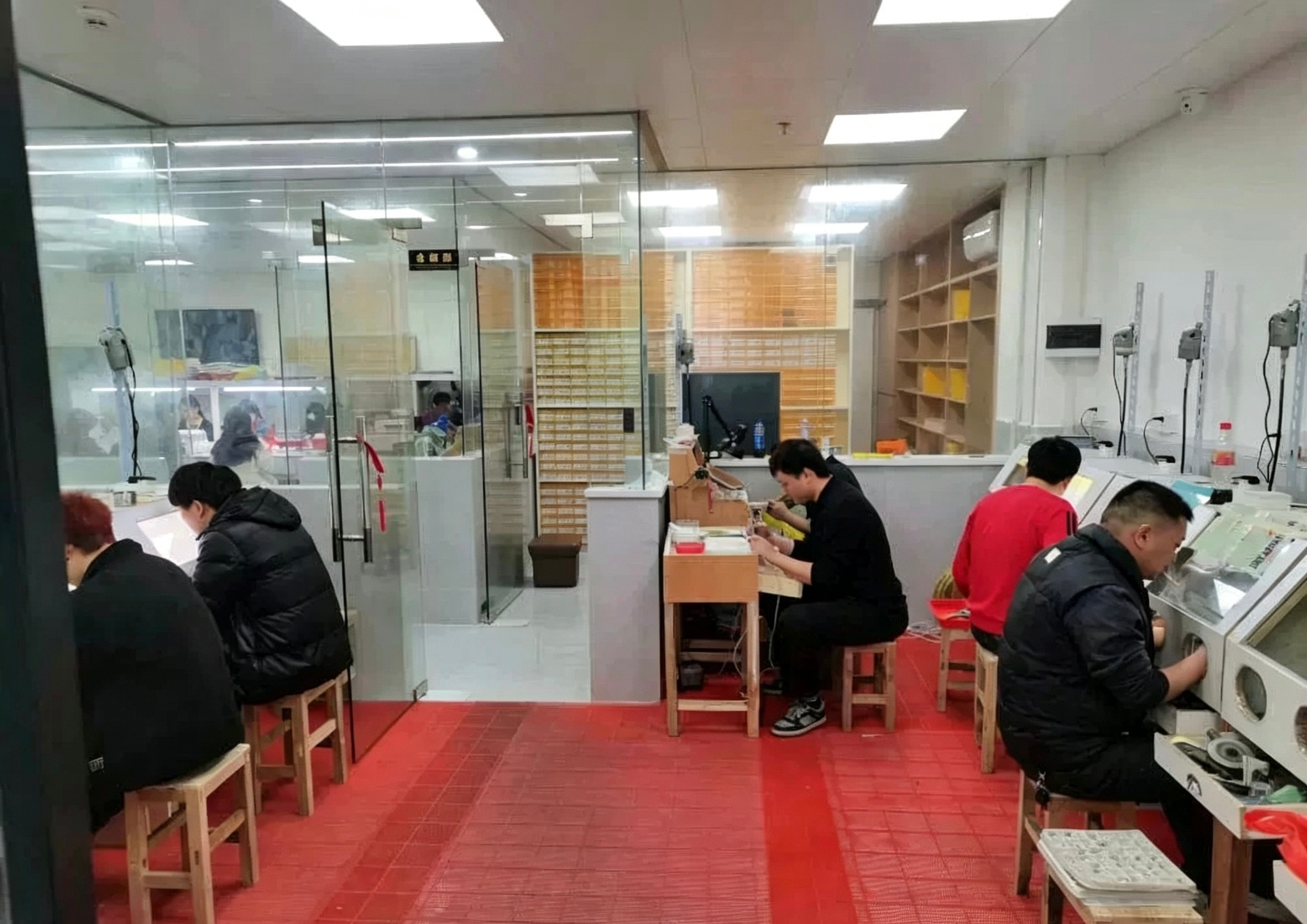
So that this article is not only advice: we are a moissanite and 925 sterling silver manufacturer in Guangdong, China, producing since June 2010. The workshop is 2,000 square metres with 46 people, and the line runs at more than 100,000 pieces a month, around 4,000 pieces a day, with more than 5,000 stock designs ready to order.
CAD and 3D modelling, wax printing and lost-wax casting, stone setting, filing and polishing, plating on our own vacuum lines, laser engraving and hallmarking, and final QC all happen in the same building. There are four QC checkpoints: incoming material, after casting, after stone setting, and before packing. We work in two materials only, solid 925 sterling silver and moissanite, which is why the process is narrow and repeatable.
More on the range: what 925 silver jewelry we make, who we supply, hallmarking, and logo and packaging.
If you want to test this list on us
Send one design you already sell, with the quantity you would actually order. You will get a quotation with the six lines above, a sampling date, and the documents in section one — before any payment. If the answer is slower or vaguer than this article suggests it should be, that is useful information too.