
Moissanite, diamond and cubic zirconia are not three grades of one stone. They are three different purchases, and choosing one decides your price point.
Most comparisons of these three stones are written for a shopper standing at a counter. This one is written for someone placing a production order: a buyer who has to choose one stone, put it into a silver line, and make the maths work after freight, duty and a resale margin. From that seat the question is never which stone is better. It is which stone fits the price the piece has to sell at.
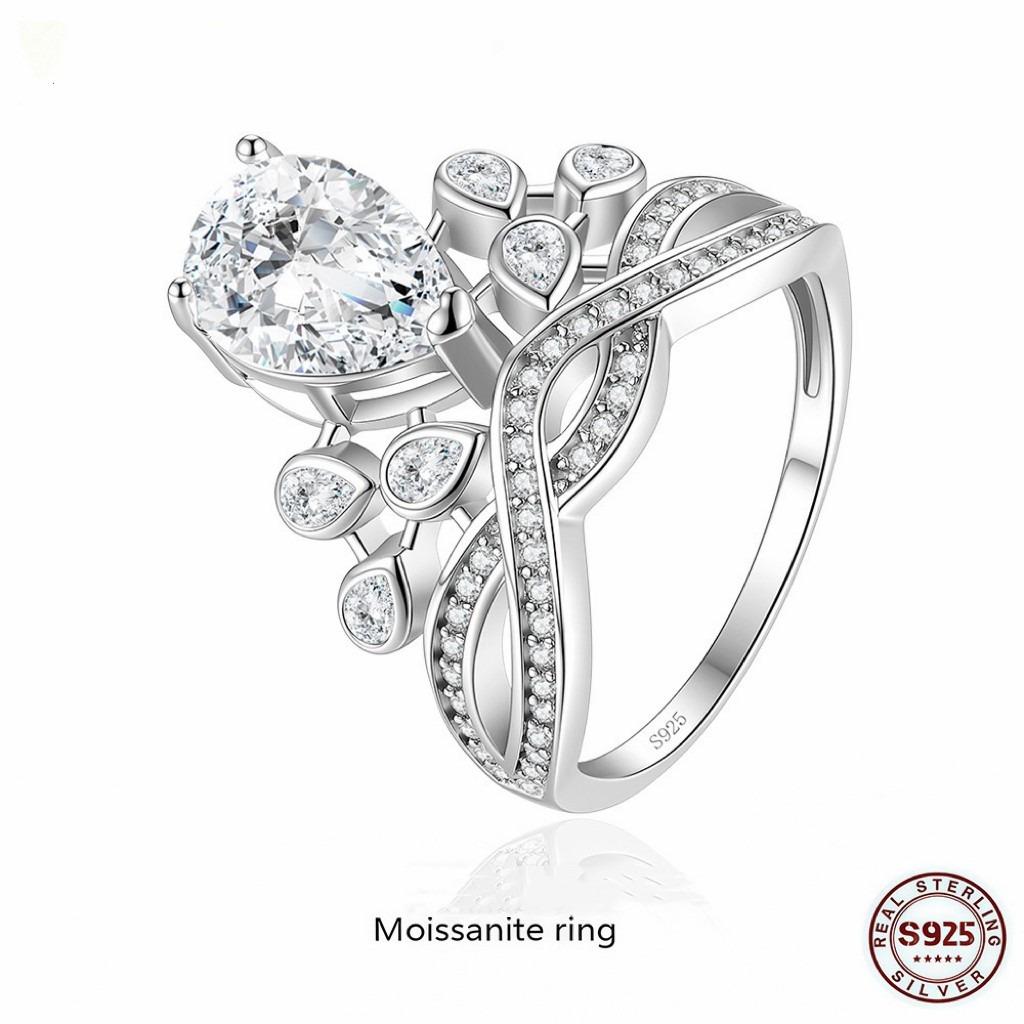
What this comparison is actually for
Three buyers ask three different questions. A bridal brand asks whether the stone will be accepted as an engagement purchase. A fashion line asks how much fire it gets per dollar. A wholesaler asks which stone keeps its appearance long enough that the order does not come back.
Those three questions point at three different stones, and none of them is wrong. What goes wrong is picking one stone for all three, which usually means a line that is too expensive for the fashion buyer and too cheap-looking for the bridal one. A mixed approach costs nothing extra to produce — the setting, the metal and the plating are the same work either way.
The three stones in one table
| Moissanite | Diamond | Cubic zirconia | |
|---|---|---|---|
| Material | Silicon carbide | Carbon | Zirconium dioxide |
| Hardness (Mohs) | 9.25 | 10 | 8.5 |
| Refractive index | about 2.65 | 2.42 | about 2.17 |
| Fire | Highest of the three | Moderate | Lower |
| Wholesale cost driver | Stone size and cut, moderate | Stone cost dominates everything | Very low per stone |
| Main risk in a resale line | Buyer expects diamond behaviour | Price ceiling on silver | Surface wear over time |
Read the rows, not the columns. The hardness row decides how a stone survives daily wear. The refractive index row decides how much light comes back. The cost row decides whether the piece can sit in a silver line at all. Diamond wins two rows outright and loses the third so decisively that a diamond set in 925 silver is almost never a sensible commercial build.
The refractive index gap between moissanite and diamond is small enough that most customers cannot separate them by eye in a shop, while the gap between either of them and CZ is visible in a side-by-side comparison under a spotlight. That is the practical meaning of the table: the first two stones belong in the same conversation, and the third belongs in a different one.
Where moissanite wins for a wholesale line
Moissanite is the only one of the three that lets a buyer offer a near-colourless, high-fire stone inside a silver price band. That single fact is why the category exists. It has enough hardness to survive daily wear without the clouding that eventually dulls cubic zirconia, and it takes a polish that keeps its sparkle through a return window and beyond.
For a manufacturer the practical advantage is that moissanite behaves like a normal setting job. It can be priced, set and plated in the same workshop that handles silver, so a line can be built without splitting production between a stone supplier and a setting house. Fewer hands on a piece means fewer points where the specification drifts between the sample and the bulk order.
The honest limit: moissanite is not a diamond and will not be accepted as one by a buyer who is buying diamond status. If the retail story depends on the word diamond, no stone substitution survives contact with the customer, however good the fire is.
Consistency between orders is the second advantage, and it is the one a wholesaler feels most. A moissanite supply line cut by the same workshop to the same tolerance means the second order matches the first without a new sample, which is what lets a buyer put a reorder on autopilot instead of re-checking every batch against a photograph.
Where diamond still wins
Diamond wins on resale expectation, on third-party certification that the market already trusts, and on the simple fact that a customer can walk into any jeweller and be understood. Those are not small advantages, and they are not technical.
They are also expensive to buy into. A diamond line carries a stone cost that dominates the bill of materials and pushes the piece out of silver into gold, because a diamond in silver reads as a compromise to the buyer even when the setting is sound. If your price ceiling allows gold and your customer base expects certification from a recognised laboratory, diamond is the correct choice and the rest of this article does not apply.
Certification is part of that cost. A diamond line usually has to carry a laboratory report per stone to be taken seriously at the price it needs to sell at, and the report is a cost line in its own right. On a moissanite line the equivalent document is a supplier card rather than a laboratory grade, which is cheaper but carries less weight with a customer who has been taught to look for one.
Where cubic zirconia is the right call
CZ earns its place in two situations: testing a shape before committing tooling to it, and filling a price band below what moissanite can reach. A CZ test piece tells you whether a silhouette sells. It costs little enough that being wrong is not expensive.
The trap is treating CZ as a permanent line. It has the lowest hardness of the three and it abrades at the facet edges, which shows up as a dull, slightly milky look after months of wear. In a market with easy returns that becomes a cost, and in a market where the same customer reorders, it becomes a lost customer. Use CZ to learn, then move the winners to moissanite.
A CZ test pays for itself when it stops you tooling a shape that would not have sold. It does not pay for itself when it sells well and you keep shipping it, because the same customer who liked the shape will notice the stone dulling before the second season. Treat a good CZ result as a signal to move the shape up the stone ladder, not as a licence to keep the price where it is.
What buyers get wrong about “D colour”
“D colour” is diamond grading language. It is borrowed for moissanite, and it does not mean the same thing. A diamond colour grade describes how far a stone sits from colourless on a scale measured under controlled lighting. On moissanite the term is used loosely to mean near colourless, and two suppliers can both say D colour while shipping stones with visibly different body tint under daylight.
The test that works is not the grade on the label. Ask for the stone photographed on plain white paper in daylight, not on a black velvet tray under a spotlight: body tint hides in showroom lighting. Then ask what the stone looks like from the side, because the tint that shows at the girdle is the one a customer notices when the piece is on a hand.
There is a second mistake in the same family: assuming one grade covers every size. A tint that is invisible in a four millimetre stone can be plain in a nine millimetre one, because there is more material for light to travel through. If a range mixes small melee with a large centre, ask for the large stone to be described separately rather than accepting one description for the whole piece.
The GRA card that comes with most moissanite is a supplier document, not a laboratory grading report, and it should be read that way. We wrote a separate guide on how to read and verify a GRA report if you want the detail of what it does and does not prove.
Setting cost, not stone cost, decides your landed price
Buyers new to the category price a piece by the stone and are surprised by the quote. The bill of materials has five parts, and on a moissanite silver piece the stone is rarely the largest:
- Metal weight — grams of silver, priced off the metal market on the day the order is cast.
- Stone cost — the count, size and cut, which is where a halo or a pavé line multiplies fast.
- Setting labour — charged per stone, and this is usually the line that decides whether a design is viable at volume.
- Finishing — polishing and plating, including how many times a piece is handled between steps.
- Tooling and packing — the mould, amortised over the run, plus the box the customer opens.
The setting labour line is the one buyers underestimate. A closed bezel takes fewer operations per stone than a four-prong basket, and a pavé field takes more than either, because every stone is set individually and then tightened. That is why two designs with the same stone count can differ substantially in price: one is a moulding problem, the other is an hour of bench work per piece. When a design has to hit a price, the cheapest change is usually the setting style, not the stone.
Buyers also over-specify in the wrong place. Upgrading the stone in a piece whose plating will wear out in a season is money spent where the customer will not see it. Moving that same budget into a heavier shank, a better clasp or a thicker plating layer changes what the piece feels like after a year, which is the point where a reorder happens or does not.
We do not publish a price list, because the number depends on the metal market, the run size and the finish. What we will do is quote against a target retail price you name, and tell you which of the five lines has to move to reach it — and say so when it cannot be reached at all. The terms that apply to any quote are on our order terms page.
How the three behave after twelve months of wear
A stone is judged twice: at the counter and a year later. The second judgement decides whether the customer comes back.
| After twelve months | What fixes it | |
|---|---|---|
| Moissanite | Keeps its fire; may hold a film of skin oil and soap | Warm water and a soft brush; no clouding to reverse |
| Diamond | Unchanged, but the girdle can chip if the setting leaves it exposed | A setting with more protection at the edge |
| Cubic zirconia | Facet edges abrade and the stone reads slightly milky | Nothing practical; the stone is replaced |
| Plating (any stone) | Rhodium wears thin at the contact points first | Re-plating, or a design that spreads contact |
Note that the last row is independent of the stone. Most complaints blamed on a stone turn out to be plating wear at the clasp, the shank or the post — the places that touch skin and fabric. On a bracelet the wear starts at the clasp; on a ring, under the finger; on studs, at the post. Designing those three points well buys more customer satisfaction than upgrading the stone.
One cheap intervention reduces returns more than any stone upgrade: tell the customer how to clean the piece. A moissanite that looks dull is almost always holding a film of hand cream, and a line of care instructions in the box turns a complaint into a repeat purchase. It costs a printed card and it addresses the most common reason a piece is sent back.
Which one to put in a 30-piece starter order
Thirty pieces is the size of order where a mix is still affordable and a single bet is still risky. A starting mix that has worked for buyers we supply:
- Roughly two thirds moissanite. This is the line you intend to keep. Put it in the shapes you are most confident about, in one or two plating colours, not five.
- Roughly one third cubic zirconia. Use it to test silhouettes you are unsure about. When a shape sells, move it to moissanite on the next order rather than reordering the CZ.
- Diamond only if the positioning demands it. A small diamond piece in a moissanite order rarely sells; it sits above the rest of the range with nothing to bridge to it.
Photograph the moissanite first. It is the line you are keeping, and the images have to work twice: on the listing, and in the customer’s hand when the parcel arrives. A piece photographed on white, on a hand and on a dark surface gives you three assets from one shoot, and the dark shot is the one that shows the fire that a white background flattens.
The rest of that sequencing — what to order first, what to photograph first, what to hold back — is in the 30-piece path. The short version is that a mixed order reads a market faster than a large single-stone order, and it costs less to be wrong.
How we quote a mixed-stone collection
Send four things and the quote comes back usable: a reference for each shape (a photo against a ruler beats a description), the stone you want in each, the plating colour, and the retail price you need to hit. With those four we can say which lines of the bill of materials have room and which are already tight.
The commercial framework is the same whatever the stone. Stock designs start at 1 piece and ship within 24 hours. Custom OEM/ODM starts at 30 pieces per design, where the mould is free; below 30 pieces the development fee is USD 45, which covers opening the mould and preparing the production files. Sampling takes 5-7 days on stock designs and 7-15 days on custom designs, production runs 7-10 days, and air freight is 7-10 days.
If you are still deciding between the three stones, the most useful next step is not another article. Send one shape you already sell and tell us the price it has to retail at. We will come back with the stone that fits that number, and say plainly if none of them does. Details on how a custom order runs are in the OEM/ODM walkthrough, and the minimum order rules are on the MOQ page.